DAO Deficiency
What’s DAO enzyme
Diamine oxidase (DAO), originally called histaminase due to its ability to inactivate the biological activity of histamine, a property of enormous importance, is the main responsible for the degradation of extracellular histamine, particularly that of dietary origin. DAO it is found in various tissues, but in mammals is especially active in the small intestine, where it is synthetized by enterocytes in the intestinal villi. It is also found in the ascending colon, placenta and kidneys.
DAO is a functional enzyme that catalyzes the oxidative deamination of the primary amine group of histamine. However, it can also metabolize other biogenic amines such as putrescine and cadaverine. We haven’t mentioned it yet, but histamine can also be metabolised by another enzyme called HNMT. However, this pathway is not relevant when we talk about dietary histamine. Although HNMT is present in the gastrointestinal tract, DAO, which is expressed at far higher levels, serves as the primary defense against exogenous histamine, whether it comes from food or is produced by the gut microbiota. Importantly, DAO activity reflects the integrity and maturity of the small intestinal mucosa. Several humans and animal studies, although more research is still needed, have shown that serum DAO activity inversely correlates with small-intestinal permeability. This is why, in patients with Crohn’s disease (CD) or ulcerative colitis (UC), DAO measurements can be useful for assessing susceptibility to Inflammatory Bowel Disease (IBD).
What’s DAO Deficiency
DAO Deficiency is an alteration in the metabolism of exogenous histamine that appears when Diamine Oxidase (DAO) enzyme activity is low. In other words, when for some reason there is a significant deficiency in the functional activity of the main enzyme in the metabolism of histamine.
When there is an alteration in the metabolism of histamine due to the insufficient DAO activity, the ratio between ingested histamine and body’s capacity to degrade it becomes unbalanced. As a result, histamine cannot be properly broken down and eliminated through urine, leading to its absorption into the bloodstream and the subsequent activation of specific histamine receptors. This process can trigger a wide range of symptoms across different organ systems.

The onset of symptoms may be associated with the intake of a wide variety of foods with highly variable histamine content. Symptoms may even appear after consuming foods that are relatively low histamine if they are consumed continuously, which explains why it is often difficult to associate a specific food with the symptomatology. When histamine accumulates, different histamine receptors in the body (H1, H2, H3 or H4) can be activated, leading to a broad range of symptoms, typically involving at least 2-3 organ systems.
Migraine is one of the most commonly reported symptoms due to its disabling nature, although DAO deficiency can be diagnosed even in its absence.
“If you suffer symptoms across two or more different organ systems, it is likely that you have DAO deficiency.”
Origin of DAO Deficiency
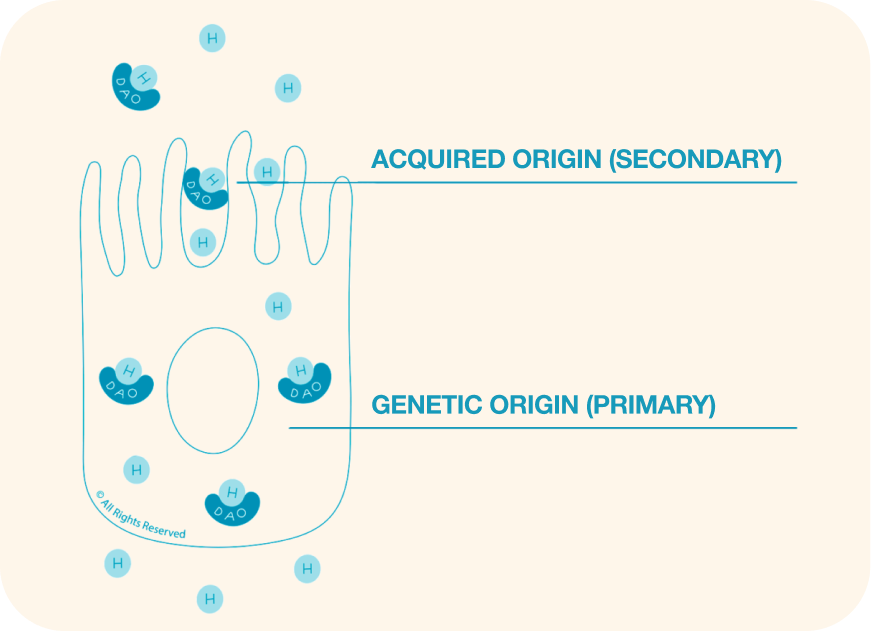
The main origin of DAO deficiency is genetics (Primary origin). It is estimated that 70-80% of cases involve a genetic predisposition with, at least, one altered variant of the AOC1 gene. As a result, some people produce little diamine oxidase or produce an enzyme that does not function efficiently.
However, several additional factors can cause or worse the condition. Some of these reduce DAO activity (Acquired origin), such as certain pathological diseases, or specific medications that can block the enzyme’s structure.
Other situations do not reduce DAO activity but instead can trigger the release of histamine from mast cells or facilitate its accumulation. These include allergies, menstruation, stress, prolonged fasting, high-intensity exercise, consumption of described histamine-releasing foods or drugs, exposure to extreme temperatures, intestinal dysbiosis, leaky gut, and the consumption of alcoholic beverages, where ethanol and histamine metabolites compete to be eliminated. The DAO enzyme is saturated and unable to carry out its function.
GENETIC ORIGIN (PRIMARY)
Genetics is the main origin of DAO deficiency (75%). In a family, the same altered variants of the AOC1 gene can be inherited and manifest different
symptoms. What is inherited is the allelic alteration and not the symptom per se.
For this reason, the same treatment can benefit a mother or father suffering from migraine and functional digestive disorders and their child with itchy skin and ADHD. From the International Institute of DAO deficiency we offer the possibility of knowing the status of the alleles of the 4 variants most associated with DAO deficiency: rs10156191, rs1049742, rs1049793 and rs2052129
“It is estimated that in around 80% of cases there is a genetic predisposition with, at least, one altered variant of the AOC1 gene”
ACQUIRED ORIGIN (SECONDARY)
There are multiple factors that can develop a DAO deficiency. These can appear in a person with or without a genetic predisposition to DAO deficiency. Factors can be classified into 2 types and some of they could be reversible:
- Pathological factors: Celiac disease or Inflammatory Bowel Disease, such as Crohn or Ulcerative Colitis, situations that generate inflammation of the intestinal mucosa such as acute gastroenteritis, intestinal dysbiosis, anorexia nervosa or intestinal resections.
- Pharmacological factors: (DAO enzyme inhibitors drugs). Current estimates suggest that around 20% of the European population regularly uses drugs that impair DAO function, substantially increasing the number of individuals vulnerable to the adverse effects of dietary histamine.